This is an English translation of the Chinese original, first published on 26 March 2025 (use the 中文 button in the menu to read it). The translation was prepared with the assistance of Claude Opus 5.5 (Anthropic).
Preface
As the first non-narrative post on this blog, it ought to have some interesting content. After some thought, I decided that nothing fits better than the first lecture of Lectures on Astrophysics by Steven Weinberg (physicist and Nobel laureate).
The whole book is 226 pages long, which is of course nowhere near enough to cover the main body of astrophysics. Instead, the author sets out to present simple calculations that, without the help of a computer, still say something about the astrophysics of the real world.
...Instead, I here offer a short course, a collection of astrophysical calculations that can be done simply and analytically, without recourse to computers, and yet are relevant to the real world....
The first section of the book, Hydrostatic Equilibrium, needs nothing more than basic calculus, the law of universal gravitation, and a few thermodynamic concepts, yet it arrives at many striking conclusions.
Gravitational equilibrium of a star
Stars[1] in the universe are usually stable sources of light, so we may assume that a star is a stable mass of matter held together by gravity. Since gravity depends only on the distance between pieces of matter, we may approximate a star as a sphere, i.e. as spherically symmetric. It is therefore convenient to work in spherical coordinates.
Recall the law of universal gravitation: \[\begin{equation} F=-G\frac{Mm}{r^2} \end{equation}\] Since gravity is universal, it naturally also acts between the parts of a star's interior. To balance this gravity and keep its structure stable, the matter inside the star must exert a certain pressure. Our starting point is exactly this balance: in a star that exists stably, the gravity between its inner parts must equal the pressure produced by the matter being packed too tightly.
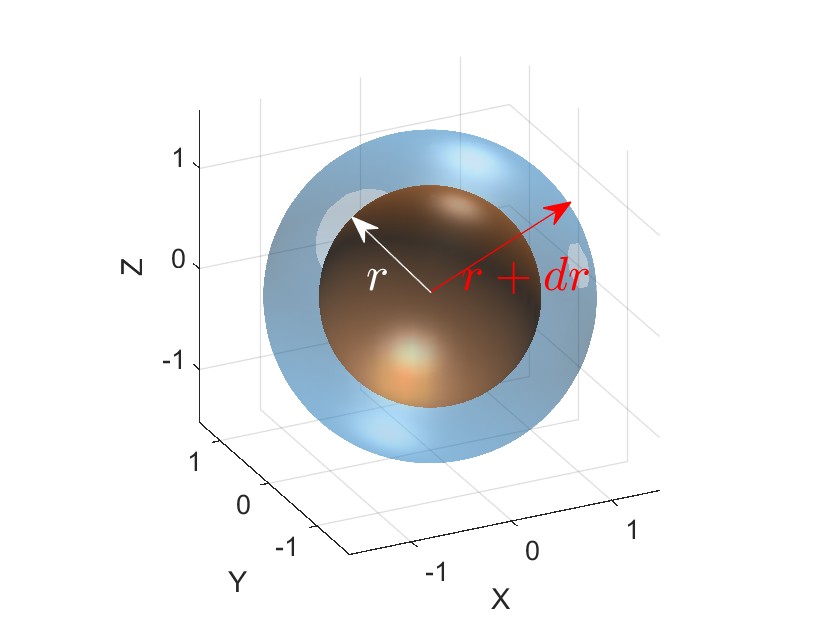 As shown in the figure above, suppose the density of the star is a
function of radius, \(\rho(r)\). Then
the mass of the inner sphere of radius \(r\) is
\[\begin{equation} \mathcal{M}(r)=\int_0^r 4\pi r'^2\rho(r')dr'. \end{equation}\]
Correspondingly, the gravitational force this sphere exerts on the shell of thickness \(dr\) just outside it (one can check that the mass of this shell is \(4\pi r^2 \rho(r)dr\)) is[2] \[\begin{equation} F_{\text{grav}}=-G\frac{\mathcal{M}(r)\times 4\pi r^2 \rho(r)dr}{r^2}=-4\pi G\rho(r)\mathcal{r}dr \end{equation}\] The minus sign indicates that gravity always points towards the centre of the sphere. Next, consider the buoyant force caused by pressure. (Just as an object in water feels buoyancy because the pressure on its bottom is larger than the pressure on its top, the same holds inside a star!) Let the pressure at radius \(r\) be \(p(r)\). Since the pressure on the inner side of the shell is larger than on its outer side, the buoyant force due to this pressure difference is \[\begin{equation} F_{\text{buoy}}=4\pi r^2\left[p(r)-p(r+dr) \right]=-4\pi r^2 p'(r)dr \end{equation}\] Because the star is stable, the gravity acting on any such shell inside the star must balance the buoyant force on it. Combining the two equations and simplifying a little, we obtain \[\begin{equation} \label{eq:hydrostatic} \boxed{\frac{dp(r)}{dr}=-\frac{G\mathcal{M}(r)\rho(r)}{r^2}} \end{equation}\] This formula relates the pressure and the mass at any radius inside the star. It is the fundamental equation of hydrostatic equilibrium for stars.
Gravitational potential energy of a star
Before discussing the energy of a star, we need to recall how energy is defined. From high-school physics: the kinetic energy of an object at rest can be increased by applying an external force that displaces it, that is, the energy of the object is increased by doing work on it, \[\begin{equation} W=\int \vec{F}\cdot d\vec{x} \end{equation}\]
For a star, what we care about is no longer kinetic energy but
gravitational potential energy: we need the work done by gravity as
matter coming in from infinity is drawn together. Since the star can be
treated as a sphere, we follow the same approach as above. We compute
the gravitational potential energy accumulated by a thin shell wrapped
around the sphere as it moves from infinity to the surface, and from it
obtain the gravitational potential energy of the whole star, as shown in
the figure below (only one element of one shell is shown, the red dot).
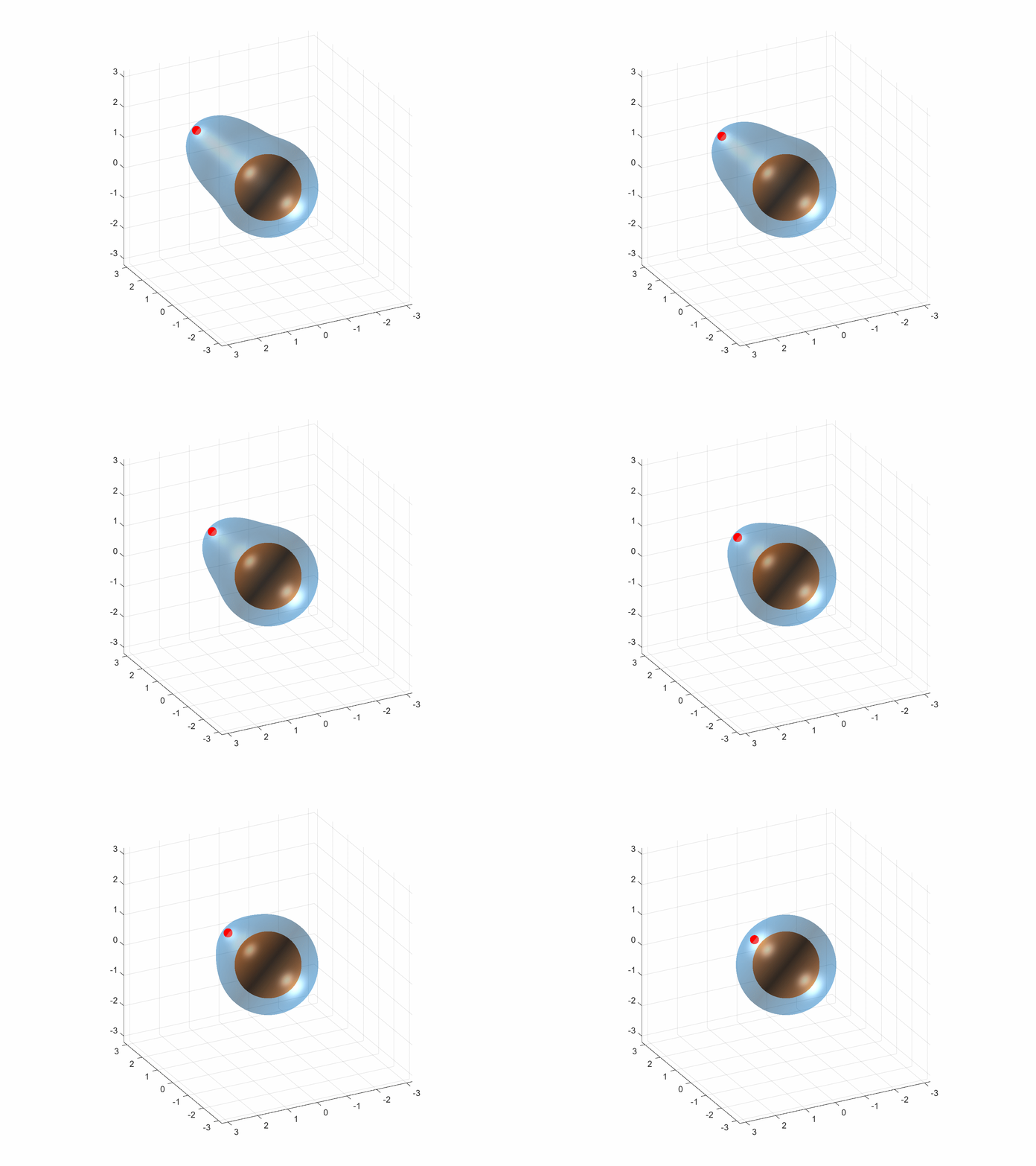
One can check that a body of radius \(r\) and mass \(\mathcal{M}(r)\) produces a gravitational field \({\color{blue}G\mathcal{M}(r)/r^2}\), and that the work it does in pulling matter from infinity onto its surface to form a shell of mass \({\color{brown}4\pi r^2\rho(r)dr}\) is \[\begin{equation} \int_{r}^{\infty}{\color{blue}G\mathcal{M}(r)/r^2}\times{\color{brown}4\pi r^2\rho(r)dr} \times{\color{red}\frac{1}{r'^2}dr'}=4\pi G r\mathcal{M}(r)\rho(r)dr \end{equation}\] Take care to distinguish the integration radius \(r'\), marked in red, from the radius \(r\) at which the shell sits! The former appears because, as the shell moves from infinity to the surface, the gravitational force on it changes with distance (universal gravitation tells us the force falls off as the inverse square of the separation), so we must integrate over it. The latter is the radius of the shell we are interested in.
Having found the work needed for the sphere of radius \(r\) to pull in a shell, we integrate over the radius up to the radius of the whole star to obtain the star's gravitational potential energy: \[\begin{equation} -\Omega=4\pi G\int_0^{\color{red}{R}} r\mathcal{M}(r)\rho(r)dr \end{equation}\] Here \({\color{red}{R}}\) is the radius of the star, which is usually defined as the place where the pressure of the star vanishes, i.e. \(p(R)=0\) (compare the Earth's atmosphere: one atmosphere of pressure inside it, and nearly zero outside). The left-hand side is the star's gravitational potential energy \(\Omega\). Note the minus sign. Gravity is always attractive, and as gravity does work, the shell being pulled in should convert the gravitational potential energy it gains into kinetic energy. In computing the shell's journey from infinity to the surface, however, we have assumed that the shell lands on the surface with no kinetic energy, forming a stable star[3]. The price for this is that the gravitational potential energy we obtain must be negative.
Now it is time to return to Eq. \(\eqref{eq:hydrostatic}\). Using it, we can rewrite the expression above as \[\begin{equation} \Omega=4\pi \int_0^R\frac{dp(r)}{dr}r^3dr=-3\int_0^R p(r)4\pi r^2 dr \end{equation}\] To obtain this equality, integrate by parts and use \(p(R)=0\) to eliminate the boundary term \(r^3p(r)|^R_0\) that the integration by parts produces.
The energy of a star
We now know the star's gravitational potential energy. In addition, the star's interior holds thermal energy \(\Upsilon\)[4] (often called internal energy). It can be written as an integral of the energy density per unit volume,
\[\begin{equation}\label{innerenergy} \Upsilon=\int_0^R\mathcal{E}(r)4\pi r^2dr \end{equation}\] where \(\mathcal{E}\) is the internal energy density, excluding the star's rest-mass energy \((E=mc^2)\) and gravitational energy. We can now write down the non-relativistic energy of the star:
\[\begin{equation}\label{energy} E=\Upsilon+\Omega=\int_0^R\left[\mathcal{E}(r)-3p(r)\right]4\pi r^2 dr \end{equation}\] From the integrand we see that if \(\mathcal{E}(r)-3p(r)<0\), the star's gravitational potential energy outweighs its internal energy, so the total energy can be negative, i.e. the star is held together.
The polytrope assumption
To discuss the energy of the star further, we digress briefly: we need some thermodynamics to relate the pressure of the star to its energy.
We usually assume that the internal energy and the pressure are related by \[\begin{equation}\label{polytrope} \mathcal{E}(r)=\frac{p}{\Gamma-1} \end{equation}\] This relation is called the polytrope assumption, and the extra parameter \(\Gamma\) is called the adiabatic index. To illustrate the relation, take the ideal gas from high school as an example. The ideal gas law reads \[\begin{equation} pV=Nk_{B}T \end{equation}\] where \(p\) is the pressure, \(V\) the volume of the gas, \(k_B\) Boltzmann's constant, \(N\) the number of atoms in the gas, and \(T\) the temperature. Using the number density per unit volume \(n=N/V\), this becomes \[\begin{equation}\label{eq:idealgas} p=nk_{B}T \end{equation}\] Thermodynamics shows that the energy density of the ideal gas is then \[\begin{equation} \mathcal{E}={\color{red}\frac{3}{2}}nk_{B}T \end{equation}\] Note the prefactor! Using \(\eqref{eq:idealgas}\) we in fact get \[\begin{equation} \mathcal{E}=\frac{3}{2}p=\frac{p}{5/3-1} \end{equation}\] so for an ideal gas we have \(\Gamma=5/3\). Besides the ideal gas, for radiation (no longer a gas of ordinary massive atoms, but a gas of massless photons) we have \(\mathcal{E}=3p\) and hence \(\Gamma=4/3\).
The explosion of a star
Having related the internal energy to the pressure, we can finally discuss the explosion of a star! Using \(\eqref{polytrope}\), \(\eqref{innerenergy}\) and \(\eqref{energy}\), we can set up a simple algebraic relation: \[\begin{equation} \begin{split} E&=\Upsilon+\Omega=\int_0^R\left[\mathcal{E}(r)-3(\Gamma-1)\mathcal{E}(r)\right]4\pi r^2 dr\\ &=(4-3\Gamma){\color{brown}\int_0^R\mathcal{E}(r)4\pi r^2 dr}=(4-3\Gamma)\times{\color{brown}C}\\ \Upsilon&={\color{brown}\int_0^R\mathcal{E}(r)4\pi r^2 dr}={\color{brown}C}\\ \Omega&=E-\Upsilon=3(1-\Gamma){\color{brown}C} \end{split} \end{equation}\] This means that the total energy, the gravitational potential energy, and the internal energy of the star satisfy the following simple algebraic relations: \[\begin{equation}\label{eq:Explode} \boxed{\Upsilon=-\frac{E}{3\Gamma-4},\quad\Omega=\frac{(\Gamma-1)E}{\Gamma-4/3}} \end{equation}\] When the total energy \(E\) is positive the star will explode, so stability requires \(E < 0\). But the gravitational potential energy is always negative, \(\Omega<0\), so the second equation above shows that we must have \(\frac{\Gamma-1}{\Gamma-4/3}>0\), which gives \(\Gamma<1\) or \(\Gamma>4/3\). From the thermodynamic discussion above, \(\Gamma\) is normally greater than 1, so we must have \(\Gamma>4/3\). In fact, for bodies whose pressure is dominated by highly relativistic particles (for example massive ordinary stars close to the theoretical mass limit, white dwarfs, and neutron stars), \(\Gamma\) is only slightly above 4/3, which shows that such bodies are in fact only marginally stable.
Equation \(\eqref{eq:Explode}\) plays a decisive role in the early evolution of stars. A cold, diffuse gas cloud has very little gravitational and internal energy, so its total energy \(E\) is small. As long as the cloud is not at absolute zero, it keeps radiating light, mostly in the infrared. Once its total energy becomes negative, the cloud can no longer disperse. By Eq. \(\eqref{eq:Explode}\), as long as the adiabatic index satisfies \(\Gamma>4/3\), then as the cloud loses energy its total energy \(E\) keeps decreasing (becoming ever more negative), yet its internal energy \(\Upsilon\) keeps increasing. In other words, the star now behaves as if it had a negative heat capacity: the more energy the star loses, the hotter it gets. As the temperature rises, the star radiates energy even faster, forming a positive feedback loop. Eventually, when the core temperature is high enough to overcome the Coulomb repulsion between nuclei, nuclear fusion switches on and keeps growing until the nuclear energy output balances the radiative losses. The star then enters a stable phase (at least until the nuclear fuel in its core runs out). Paradoxically, the onset of nuclear reactions is what stops the star from heating up further.
- 1.Stars (Stars) here always means luminous stars, not rocky planets like the Earth (Rocky planet), because almost all the bodies visible to the naked eye in the night sky are stars that shine by their own nuclear reactions. ↩︎
- 2.Note that we have used a property of gravity here: the gravitational force a sphere exerts on a body outside it equals the force exerted by a point mass of the same mass placed at the centre of the sphere. Thanks to this property, when we consider the gravity of the inner sphere on the shell, we need not consider the force from every point of the inner sphere on the shell; we simply replace the distance by the distance from the centre to the shell. ↩︎
- 3.This is in fact related to how stars form. Broadly speaking, a star forms as interstellar matter is drawn together by gravity. The kinetic energy that gravitational potential energy turns into at this stage is very large, so the interstellar matter collides and rubs against itself, and in the process kinetic energy is converted into heat and radiation that leave the system, reducing the kinetic energy. Even with this process, the kinetic energy is not completely used up once the star has formed. ↩︎
- 4.This symbol is the Greek letter Upsilon, kept the same as in the original book. ↩︎